Key Takeaways
- Infertility is typically diagnosed after 12 months of trying (under 35) or 6 months (35 and above).
- You should seek help earlier if there are irregular cycles, painful periods, prior pelvic infections, miscarriages, or known medical conditions.
- Fertility assessment involves both female and male partners.
- Early evaluation does not automatically mean IVF — many cases are manageable with simpler treatments.
- Seeking help is not a sign of failure — it is a proactive medical decision.
Infertility is medically defined as not achieving pregnancy after 12 months of regular, unprotected intercourse — or after 6 months for women 35 years of age or older.
If you have irregular periods, known reproductive conditions, previous miscarriages, or male-factor concerns, it is advisable to seek medical evaluation earlier.
This guide is designed to give you clarity on when you should see a gynecologist or doctor — so you can decide on getting the best fertility screening packages with confidence.
When Does Infertility Become a Medical Concern?
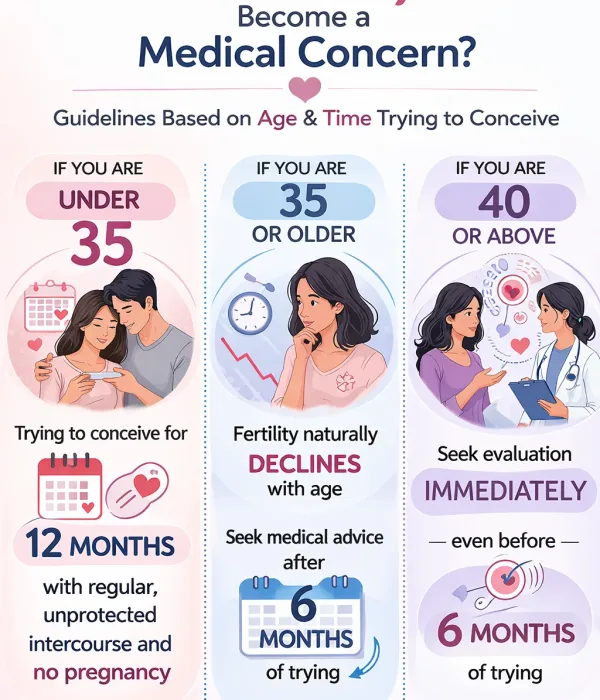
If You Are Under 35
If you have been trying to conceive for 12 months with regular, unprotected intercourse and have not conceived, it is advisable to consult a gynecologist or doctor.
If You Are 35 or Older
Fertility naturally declines with age, and earlier assessment can improve outcomes. It is advisable to seek medical advice after 6 months of trying.
If You Are 40 or Above
It is reasonable to seek evaluation immediately, even before 6 months of trying. These timelines are widely accepted in clinical practice and reflect how fertility changes with age.
Situations Where You Should See a Specialist Earlier
Infertility affects both men and women, and in many cases, both partners contribute to the difficulty of conceiving. A balanced evaluation saves time and reduces unnecessary stress.
You do not need to wait the full 6–12 months to visit a fertility centre. Consider booking an appointment with your nearest fertility centre if you experience the following:
For Women
- Irregular or absent menstrual cycles: You may not be ovulating regularly.
- Extremely painful periods or chronic pelvic pain: Could signal endometriosis or underlying pelvic problems.
- Known PCOS or endometriosis: These conditions can affect ovulation and fertility.
- Previous pelvic infections or tubal surgery: May cause blocked or damaged fallopian tubes.
- Two or more miscarriages: Recurrent loss needs medical evaluation.
- Thyroid disorders or uncontrolled diabetes: Hormonal imbalance can interfere with conception.
For Men
- History of testicular injury or surgery: May affect sperm production.
- Erectile or ejaculation difficulties: Can prevent sperm from reaching the egg.
- Known low sperm count: Reduces chances of natural fertilisation.
- Previous chemotherapy or radiation treatment: May impact sperm quality and quantity.
Should You See an OB-GYN or a Fertility Specialist?
Many couples feel uncertain about where to begin. The good news is that both an OB-GYN (Obstetrician and Gynaecologist) and a fertility specialist play an important but slightly different role in your fertility journey.
A fertility specialist can provide comprehensive assessment, including ovarian reserve testing, tubal evaluation, and semen analysis, and guide you through treatment options.
Start with an OB-GYN if:
- You have just reached the 6–12 month mark
- You need a basic fertility screening
- You suspect hormonal issues
Consider a Fertility Specialist if:
- You are 35+ and have been trying for 6 months
- You are 40+
- You have known reproductive conditions
- You prefer a structured fertility plan and advanced testing
What Happens During a Fertility Evaluation?
If you’ve never been through a fertility check before, it’s completely normal to feel nervous.
But here’s the good news. The first visit is usually more conversation than procedures. Understanding what to expect can make the process feel much less overwhelming.
Step 1: A Detailed Medical History
Your doctor will spend time getting to know both of you. This helps build a clear picture before ordering any tests.
You may be asked about:
- How long you’ve been trying to conceive
- Your menstrual cycle patterns
- Any past pregnancies or miscarriages
- Existing medical conditions or medications
- Lifestyle factors such as stress, sleep, smoking, or weight changes
- This step is important — many fertility clues come from your history alone.
Step 2: Initial Tests
After the discussion, your doctor may recommend some basic tests.
For women, this may include:
- Hormonal blood tests to check ovulation and reproductive hormones
- A pelvic ultrasound to examine the uterus and ovaries
- Ovulation tracking to confirm if and when eggs are released
- Sometimes, tests to check if the fallopian tubes are open
For men, this usually includes:
- A semen analysis to assess sperm count, movement, and shape
Most of these tests are straightforward and done step by step. Not everything happens at once — your doctor will guide you through what is necessary and when.
The goal is simple: find clear answers so you can move forward with confidence.
Step 3: Personalised Treatment Plan
Not every fertility journey leads to IVF. Many couples can conceive with early medical guidance and treatment. Any given treatment depends on the diagnosis and may include:
- Ovulation induction medication: Stimulates ovulation to increase chances of natural conception.
- Hormonal regulation: Corrects hormonal imbalances affecting ovulation and menstrual cycles.
- Surgical correction (if needed): Treats structural issues like fibroids, endometriosis, or blocked tubes.
- Assisted reproductive techniques (such as IUI or IVF): Medical procedures helping fertilisation when natural conception is difficult.
Common Causes of Infertility
In some cases, doctors may not immediately find a clear causes of infertility. However, they are treatable once properly assessed like:
- Ovulation disorders (e.g., PCOS): Irregular or absent ovulation may prevent egg release.
- Endometriosis: Tissue growing outside the uterus, affecting fertility.
- Blocked fallopian tubes: Egg and sperm cannot meet for fertilisation.
- Male-factor infertility: Low sperm count or poor sperm movement.
- Age-related decline in egg quality: Egg number and quality decrease with age.
- Unexplained infertility: Tests appear normal, but pregnancy hasn’t occurred.
Emotional Impact on Infertility: You Are Not Alone
“According to estimates cited from Malaysia’s National Population and Family Development Board (LPPKN), infertility affects about 10% to 15% of couples in Malaysia.”
Struggling to conceive may affect many aspects of your life and emotional well-being such as:
- Self-esteem
- Marriage dynamics
- Mental health
In Malaysia, conversations around infertility are becoming more open, but stigma can still linger. It is important to remember that infertility is a medical condition — not a personal failure.
Speaking to a doctor can often bring clarity, direction, and a renewed sense of control.
Practical Steps While Waiting for Consultation
While preparing for your appointment, consider:
- Maintaining a healthy body weight
- Avoid smoking and excessive alcohol
- Taking folic acid supplements
- Tracking menstrual cycles accurately
- Reducing chronic stress where possible
These measures support overall reproductive health but are not substitutes for medical evaluation.
Further reading: How to Choose the Right Fertility Centre
Conclusion: Taking the Next Step with Confidence
Knowing when to see a gynecologist or a doctor to increase your chances of conceiving is not about rushing into treatment — it is about making informed decisions at the right time.
If you have been trying for:
- 12 months (under 35)
- 6 months (35 and above) or
- If you have a medical condition, it may be time for professional guidance.
At SR Women and Children, couples receive compassionate, evidence-based fertility care tailored to their individual needs. We understand that fertility is both a medical and emotional journey.
Under the care of Dr Tey Shea Reen, patients benefit from personalised fertility assessments, clear explanations, and thoughtful treatment planning. Whether you need basic evaluation or advanced fertility management, the goal is always the same: clarity, support, and responsible medical care.
Book an appointment with us today to get an early evaluation.
Disclaimer: This article is intended for general informational purposes only and does not replace professional medical advice, diagnosis, or treatment. Individual recommendations vary depending on age, medical history, and examination findings. Please consult a qualified healthcare provider for personalised assessment.
Source list:
- ACOG — “Evaluating Infertility” (FAQ) (guidance on 12 months <35, 6 months ≥35; earlier evaluation when indicated).
- PubMed (ACOG Committee Opinion listing) — “Female Age-Related Fertility Decline” (supports expedited evaluation after 6 months if >35 and more immediate evaluation at older ages).
- WHO — News release: “1 in 6 people globally affected by infertility” (4 Apr 2023) (global prevalence estimate).
- WHO — Infertility fact sheet (28 Nov 2025) (definition and prevalence framing; updated reference).
- WHO — Infertility health topic page (definition: failure to achieve pregnancy after 12 months or more of regular unprotected intercourse).
- ASRM — Committee Opinion: “Definition of infertility” (2023) (clinical definition and timing).
- ACOG — “Repeated Miscarriages” (FAQ) (evaluation recommended after two or more miscarriages).
- ASRM — “Evaluation and treatment of recurrent pregnancy loss” (Committee Opinion, 2012) (RPL definitions and evaluation context).
- Malaysia MOH / MAHTAS PDF — “Acupuncture as an adjunct treatment in subfertility” (cites LPPKN estimates used to support Malaysia prevalence ranges; useful for correcting DOSM attribution).
- NIH/PMC (peer-reviewed review, 2022) — stress and ovulatory dysfunction/menstrual effects (supports careful wording that chronic stress can disrupt cycles/ovulation, without overstating it as a primary cause).
Frequently Asked Questions About Navigating Infertility
-
How common is infertility in Malaysia?
Globally, infertility affects about 1 in 6 people during their lifetime. Local trends reflect similar concerns, especially with delayed childbearing and lifestyle-related factors.
-
Does stress cause infertility?
Stress alone isn’t the main contributing factor to infertility, but chronic stress can disrupt hormonal balance and ovulation. Managing stress supports overall health but should not replace medical assessment.
-
If I already have one child, can I still be infertile?
You may, and this is called secondary infertility — difficulty conceiving after a previous pregnancy.
-
Is fertility treatment expensive?
Costs vary depending on the level of care required. Some cases only require medication or simple monitoring. Public healthcare and selected government-supported services may offer more affordable options.
-
What are common lifestyle factors affecting fertility?
Unhealthy weight, smoking, heavy alcohol consumption, poor diet, chronic stress, lack of sleep, excessive exercise, and exposure to toxins can disrupt hormones, ovulation, and sperm quality in both men and women.
-
What are the causes of male infertility?
Low sperm count, poor sperm movement or shape, hormonal imbalance, varicocele, genetic conditions, infections, testicular injury, erectile or ejaculation disorders, and prior chemotherapy or radiation can impair male fertility.