Key Takeaways
- PCOS (Polycystic Ovary Syndrome) is a common endocrine condition that affects ovulation, metabolism, and hormone balance.
- The LH/FSH ratio helps doctors assess ovulation health; elevated LH levels can prevent proper egg release.
- Insulin sensitivity plays a major role in PCOS because high insulin can increase testosterone production.
- PCOS management focuses on long-term stability, not a quick cure. Small consistent improvements often bring meaningful results.
Polycystic Ovary Syndrome (PCOS) is a hormonal condition where elevated androgens and insulin resistance disrupt the normal ovulation cycle.
Some women with PCOS show higher LH relative to FSH, which can be associated with ovulation disruption. However, the LH:FSH ratio isn’t a standalone diagnostic test and can be normal in many PCOS cases
Many women first begin exploring PCOS after noticing symptoms such as:
- Irregular cycles
- Persistent acne
- Low energy
- Unexpected changes in hair growth.
These experiences can feel confusing or even discouraging, but they are often signals that the body’s hormonal system needs support.
Understanding the “why” behind PCOS can make the condition far less overwhelming, so let our women and children specialist explain it for you.
PCOS in Malaysia: How Common Is It?
PCOS is one of the most common hormonal conditions affecting women worldwide, and Malaysian data shows that it may affect a significant portion of the population.
“A Malaysian study among female university staff (UPM) reported a 12.6% prevalence of PCOS using the Rotterdam criteria.”
This means that about 1 in 8 women may experience the condition during their reproductive years.
Globally, PCOS is estimated to affect around 10–13% of women, and many people remain undiagnosed according to WHO.
Note: Because PCOS is closely linked with insulin resistance, Malaysia’s broader metabolic health picture matters too, NHMS reports overweight/obesity rising to 54.4% (2023) and diabetes prevalence at 15.6% among adults.
How Does PCOS Develop?
PCOS does not occur because of a single cause. Instead, it usually develops from a combination of genetics, insulin resistance, and hormonal imbalance that affects how the ovaries function.
Genetics
Many women with PCOS have a family history of the condition or related hormonal issues. If close relatives have PCOS, insulin resistance, or irregular cycles, the likelihood of developing it may be higher.
Insulin Resistance
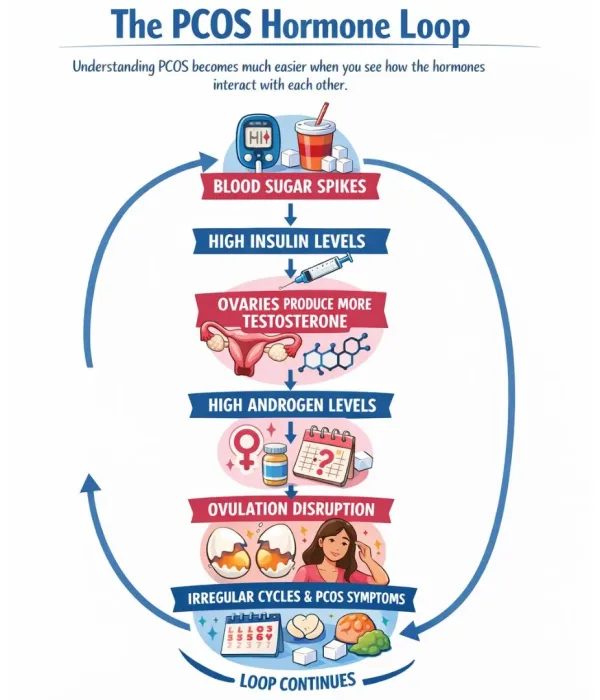
Insulin resistance is one of the most common drivers of PCOS. When the body produces excess insulin, it can stimulate the ovaries to produce more androgens (such as testosterone), which may disrupt ovulation.
Hormonal Signaling
PCOS can also affect how the brain communicates with the ovaries. Many women with the condition have higher levels of Luteinizing Hormone (LH) compared to Follicle Stimulating Hormone (FSH), which can prevent the ovaries from releasing an egg during the menstrual cycle.
The Result
These factors together can lead to:
- Irregular menstrual cycles
- Elevated androgen levels
- Multiple immature follicles in the ovaries
While PCOS cannot be traced to a single cause, understanding these hormonal interactions helps explain why metabolic health, hormone balance, and lifestyle support play such an important role in managing the condition.
Early Signs of PCOS Many Women Overlook
PCOS symptoms often develop gradually, which means many women live with the condition for years before receiving a diagnosis.
Some early signs may seem minor or unrelated at first, but together they can indicate that hormonal balance needs attention.
Common early signs include:
- Irregular menstrual cycles or periods that occur more than 35 days apart
- Persistent acne, particularly along the jawline or chin
- Increased facial or body hair growth
- Hair thinning on the scalp
- Unusual fatigue or low energy levels
- Difficulty maintaining a stable weight
Because these symptoms can appear slowly, they are sometimes mistaken for normal hormonal fluctuations or stress.
If several of these signs occur together, it may be worth discussing them with a healthcare provider and requesting hormonal testing.
How Doctors Diagnose PCOS
Doctors commonly use the Rotterdam Criteria, one of the most widely accepted international guidelines for diagnosing PCOS.
Under this framework, a diagnosis typically requires two of the following three features.
Diagnostic Criteria | What It Means |
Irregular or absent ovulation | Menstrual cycles may be longer than 35 days or unpredictable |
Elevated androgens | Symptoms may include acne, hair thinning, or increased facial hair |
Polycystic ovaries on ultrasound | Multiple small follicles visible on the ovaries |
Doctors often perform blood tests to rule out other hormonal conditions as well.
Common Blood Tests Used for PCOS Evaluation
Hormone Test | What Doctors Look For |
LH (Luteinizing Hormone) | Often elevated relative to FSH |
FSH (Follicle Stimulating Hormone) | Helps assess ovulation signaling |
Total Testosterone | Indicates androgen excess |
Fasting Insulin | Identifies insulin resistance |
HbA1c / Glucose | Evaluates blood sugar regulation |
These tests allow clinicians to determine whether symptoms are primarily related to ovulation disruption, metabolic imbalance, or androgen excess.
How Does Insulin Influence Your Hormonal Profile?
Insulin is one of the most important hormones involved in PCOS.
Many women with PCOS experience insulin resistance, meaning their cells do not respond efficiently to insulin. To compensate, the pancreas produces higher amounts of insulin.
Excess insulin can stimulate the ovaries to produce more androgens, particularly testosterone.
This hormonal shift may lead to symptoms such as:
- Acne
- Thinning scalp hair
- Increased facial or body hair
Improving insulin sensitivity can help break this cycle. Some supportive strategies include:
- Pairing carbohydrates with protein and fiber
- Choosing lower glycemic foods
- Maintaining consistent meal timing
- Engaging in regular physical activity
Even small improvements in metabolic health can significantly influence hormone balance.
Read more: When to See a Gynaecologist: A Guide for Women
Can Lifestyle Adjustments Really Cure PCOS?
PCOS is generally considered a long-term endocrine condition, which means it cannot be permanently cured.
However, many women successfully manage symptoms so effectively that cycles become regular and symptoms improve dramatically.
Rather than focusing on a cure, it is often more helpful to think in terms of supporting the body’s regulatory systems.
Research by the Endocrine Society clinical shows that even a 5% improvement in metabolic health or body composition can improve ovulation frequency and reduce androgen levels.
Supportive lifestyle strategies may include:
- Low-glycemic nutrition
- Anti-inflammatory foods
- Consistent exercise
- Quality sleep
- Stress management
These approaches help stabilize the hormonal environment that influences ovulation and metabolism.
What Supplements Are Proven to Help?
Certain supplements have been widely studied for their potential role in supporting women with PCOS.
However, we must stress it is always best to consult with your healthcare provider or a specialist before taking any supplements.
Inositol
Myo-inositol helps improve insulin signaling at the cellular level. By improving insulin sensitivity, it may indirectly reduce excess androgen production and support ovulation.
Magnesium
Magnesium supports:
- Glucose metabolism
- Nervous system balance
- Muscle relaxation
Many women with PCOS may benefit from magnesium if they experience fatigue, stress, or sleep disturbances.
“Some studies suggest a 40:1 myo-inositol:D-chiro-inositol formulation may perform better than other ratios for ovulation-related outcomes in PCOS but supplements should still be used with medical guidance.”
These supplements are often used as part of a broader medical plan developed with healthcare professionals.
Best Diet for PCOS
Nutrition plays a significant role in managing PCOS because stable blood sugar levels help reduce insulin spikes that influence hormone production.
The goal is not strict dieting, but rather choosing foods that support steady energy and metabolic balance.
PCOS-Friendly Food Choices
Many everyday Malaysian foods can support hormonal health when prepared in balanced portions.
Food Category | Better Choices | Why It Helps |
Carbohydrates | Brown rice, quinoa, oats | Lower glycemic impact |
Protein | Eggs, fish, chicken, tofu | Supports stable blood sugar |
Healthy fats | Avocado, nuts, olive oil | Helps reduce inflammation |
Vegetables | Kangkung, broccoli, spinach | Supports hormone metabolism |
Some great meal ideas include:
- Brown rice with grilled ikan kembung and stir-fried vegetables
- Oatmeal with nuts and berries for breakfast
- Tofu or tempeh stir-fry with leafy greens
- Grilled chicken with avocado salad
These meals combine fiber, protein, and healthy fats, which helps prevent sharp blood sugar spikes that can worsen insulin resistance.
Small dietary adjustments often have a meaningful impact when practiced consistently.
What Are the Signs That Management Is Working?
Hormonal improvements usually appear gradually rather than overnight.
It takes around 90 days for an egg to mature, so noticeable changes may take several cycles.
However, many women notice early signs of improvement such as:
- More stable energy levels
- Reduced sugar cravings
- Clearer skin
- Improved mood stability
- More predictable cycles
These signs often indicate that the body’s hormonal signals are stabilizing.
Where Can Women Get PCOS Support in Malaysia?
Women who suspect they may have PCOS can seek evaluation and treatment through Malaysia’s public and private healthcare systems.
Government Clinics (MOH)
The Ministry of Health Malaysia (MOH) provides women’s health services through:
- Klinik Kesihatan (KK)
- Hospital O&G departments
- Family medicine specialists
These clinics can help with:
- Hormonal blood tests
- Ultrasound scans
- Menstrual health consultation
- Referrals to gynecologists or endocrinologists
Patients usually start at a Klinik Kesihatan, where doctors can assess symptoms and refer cases requiring specialist care.
Public Hospital Referrals
If further evaluation is needed, patients may be referred to hospitals such as:
- Hospital Kuala Lumpur (HKL)
- Hospital Putrajaya
- University Malaya Medical Centre (UMMC)
These centers provide more advanced testing, including reproductive endocrinology and fertility services.
Public healthcare in Malaysia is heavily subsidized, making it an affordable option for many women seeking PCOS evaluation.
Finding Calm in Your Health Journey
PCOS can feel overwhelming at first, especially when symptoms affect multiple aspects of health. However, understanding the condition often brings clarity and reassurance.
At SR Women & Children Specialist, we believe that every woman deserves clear answers and compassionate care when navigating hormonal health concerns.
Led by the very experienced Dr Tey Shea Reen, If you are experiencing irregular cycles, persistent acne, fertility concerns, or other symptoms that may be related to hormonal imbalance, we are here to help you take the next step with confidence.
Reach out to our clinic to schedule a consultation and begin your journey toward better hormonal and reproductive health!
Disclaimer: The information in this article is provided for education only and does not replace professional medical advice. Always consult a doctor before starting, stopping, or changing any treatment, medication, or supplement (including inositol or magnesium), especially if you are trying to conceive, pregnant, breastfeeding, or have conditions such as diabetes or thyroid disorders.
Source:
- World Health Organization (WHO) — Polycystic ovary syndrome (PCOS) — Fact sheet — 22 Jan 2026
- Institute for Public Health (IKU), Ministry of Health Malaysia — National Health and Morbidity Survey (NHMS) 2023: Non-communicable Diseases & Healthcare Demand — Technical Report — 2024 (publication year)
- Institute for Public Health (IKU), Ministry of Health Malaysia — NHMS 2024: Nutrition, Volume II (Findings) — 2025 (publication year)
- Dashti S, et al. — Prevalence of PCOS among female staff at Universiti Putra Malaysia (Rotterdam criteria) — 2019
- Goh XH, et al. (Frontiers in Endocrinology) — PCOS prevalence/knowledge/practices study in Klang Valley (community sample) — 2022
- Monash University (on behalf of the international guideline group) — International Evidence-Based Guideline for PCOS (2023) — Summary PDF — 2023
- Review (PMC) — Current guideline-based approaches to diagnosis/management of PCOS (summary of guideline evolution and recommendations) — 2023
- Review (PMC) — LH/FSH patterns in PCOS and limitations of LH:FSH ratio as a diagnostic tool — 2020
- Nordio M, Proietti E (PubMed) — Evidence on myo-inositol + D-chiro-inositol (including 40:1 ratio) in PCOS — 2019
- Ministry of Health Malaysia (MOH) — Operational/Service Policy document for Obstetrics & Gynaecology services (public system pathways/referrals)
- LPPKN (National Population and Family Development Board, Malaysia) — Klinik Nur Sejahtera / reproductive health clinic information
Frequently Asked Questions About PCOS and Hormones
-
Can you have PCOS even if your periods are regular?
Yes. Some women may have normal cycles but still experience elevated androgen levels or polycystic ovaries visible on ultrasound.
-
Does PCOS always cause weight gain?
Not necessarily. While insulin resistance can make weight management more challenging, improving insulin sensitivity often helps stabilize metabolism.
-
How does PCOS affect mental health?
Hormonal imbalances may contribute to anxiety, fatigue, and mood changes. Addressing metabolic and hormonal factors often improves emotional wellbeing.
-
Do I need to completely avoid sugar?
Complete restriction is rarely necessary. Pairing carbohydrates with protein and fiber helps stabilize blood sugar levels.
-
Can PCOS symptoms change with age?
Yes. PCOS symptoms often evolve as hormone levels change throughout life.
-
What should I do first if I suspect PCOS?
Consult a healthcare provider and request hormonal blood tests early in your menstrual cycle to evaluate LH, FSH, testosterone, and insulin levels.